

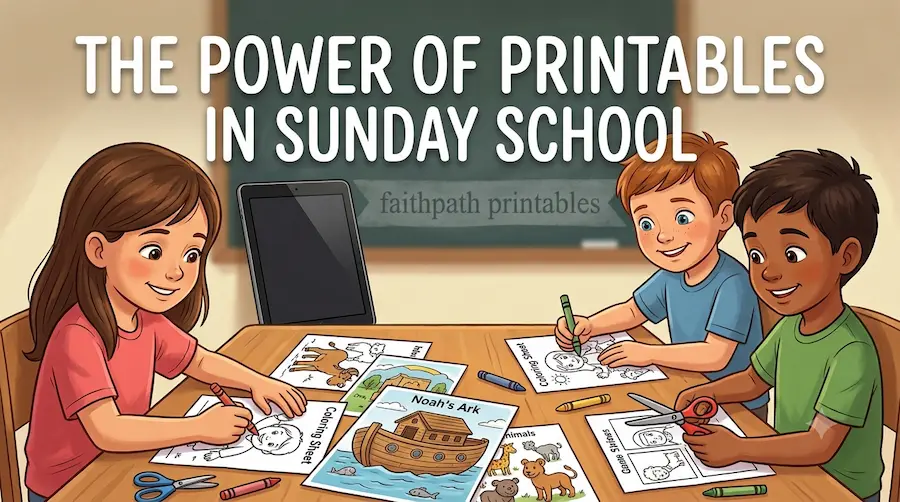
Deciding between Sunday school printables vs screens is one of the most important curriculum choices a modern children’s ministry leader can make. When Sunday morning rolls around, the average child has already spent dozens of hours staring at tablets, TVs, and smartphones.
Take a look around any waiting room, restaurant, or living room, and you’ll see the same familiar sight: children with their eyes locked onto glowing screens. By the time Sunday morning rolls around, the average child has already spent dozens of hours staring at tablets, TVs, and smartphones.
Once they step into our classrooms, they don’t need another screen. They need connection.
The Screen Trap: Passive Consumers vs. Active Learners
When a screen turns on in a classroom, it immediately pulls focus in a very specific way. Screens are designed to be consumed. Children have been deeply conditioned by modern technology to sit back, quiet down, and absorb content passively when a video plays.
Printables do the exact opposite.
When you place a physical, printed activity sheet, a scripture coloring page, or a tangible matching game in front of a child:
- Their hands are activated: Fine motor skills are engaged as they color, cut, fold, or write.
- Their brains wake up: They have to actively process the page in front of them to complete the activity rather than letting a video do the thinking for them.
- The pace slows down: Paper doesn’t flash or change frames every three seconds. It allows a child to linger on a Bible verse or a biblical concept at their own speed.
Removing the Digital Distraction
When you hand a child a tablet for a lesson, distraction is only moments away. Within two minutes, they are already swiping out of the app to play games or check the camera. Screens bring an invisible layer of competition to your classroom. You aren’t just competing with the lesson; you are competing with the child’s urge to interact with the device itself.
Paper has no notifications. It has no battery life to monitor, no Wi-Fi connection to lose, and no hidden apps. A printable sheet presents the lesson and only the lesson. It removes the digital noise, creating a quiet space where a child can focus on the message of the day.
Printables Spark Eye Contact and Conversation
Real discipleship happens through relationships. But screens are fundamentally isolating. When three kids are crowded around an iPad, they are looking at the glass—not at each other, and certainly not at you.
Printables naturally foster a shared, communal environment.
- Sharing resources: “Can you pass the blue crayon?” or “Can I borrow your scissors?” naturally triggers polite, peer-to-peer interaction.
- Side-by-side chatting: Because coloring and writing don’t require 100% of a child’s mental processing power, their mouths are free to talk. This is the golden zone for Sunday School teachers. While hands are busy coloring a scene of Noah’s Ark, you can ask meaningful questions about trust, obedience, and God’s promises.
- Eye contact: Without a glowing screen blocking their view, kids look up at you and at each other.
The “Take-Home” Bridge to Family Discipleship
One of the biggest flaws of a screen-based Sunday School lesson is that it disappears the moment the screen turns off. When parents pick up their kids and ask what they learned, the common response is a shrug. Often, the child simply replies, “We watched a video.”
A physical printable is a tangible bridge to the home.
When a child walks out of class holding a beautifully colored verse, a completed puzzle, or a paper craft they made themselves, they are holding a trophy of their learning. It is a visual cue for parents. It sits on the kitchen counter or gets stuck to the refrigerator door, serving as a physical reminder of God’s truth throughout the busy week ahead.
The Bottom Line: Technology has its place, but our Sunday School rooms should be a sanctuary from the digital noise. By choosing physical printables, you aren’t going old-fashioned but are intentionally choosing connection, conversation, and hands-on discipleship over passive screen time.
Looking for clean, “open-and-go” printable Sunday school lessons designed to make substitute teaching completely stress-free? Download a free sample Sunday School curriculum bundle here and equip your classrooms with high-quality, minimal-prep resources today.
