

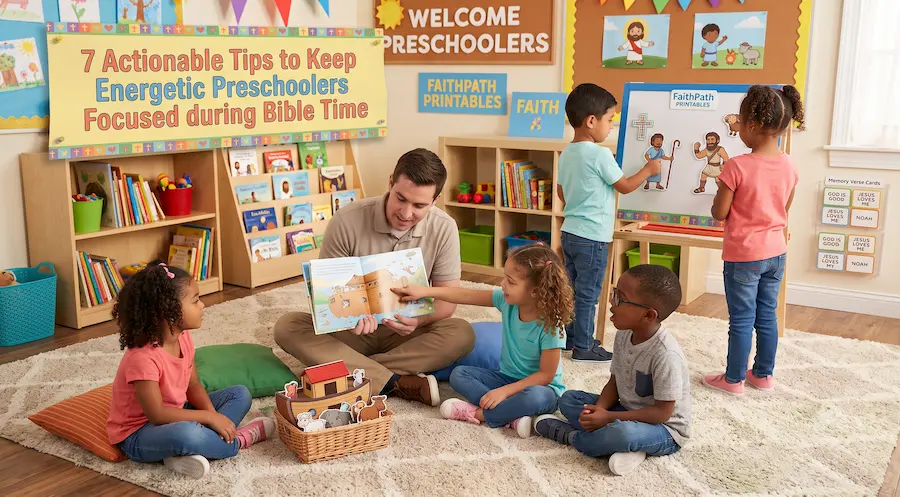
Teaching preschool Sunday school activities presents unique joys and significant challenges. Children ages 3–5 bring incredible energy to class every week. However, they also possess very short attention spans. Consequently, a great lesson plan can easily collapse without effective engagement strategies. This article shares seven practical tips to keep little hearts and busy hands focused on God’s Word.
1. Alternate Passive and Active Learning Phases
Preschoolers generally cannot sit still for very long. Therefore, you must build intentional rhythm into your lesson time. Instead of trying to teach a 20-minute seated lesson, create 5-to-7-minute blocks. Start with 5 minutes of physical movement (like singing or an action game), then transition to a 7-minute seated lesson (like a Bible story with props). Immediately follow this with 5 minutes of hands-on work (like coloring). This constant shifting resets their internal clocks and prevents restlessness from setting in.
2. Open with Movement-Based Scripture Games
First, you must capture their physical energy constructively. Begin your time together not with a story, but with movement. For example, use classic, high-energy games with a Bible twist. Try “Noah Says” (instead of Simon Says), have them hop like frogs to represent an Egyptian plague, or play tag where they must shout a simple memory verse to be safe. By allowing them to move and exert energy early, they will be much more prepared to sit quietly and listen to the core Bible story later.
3. Use Hands-On Visual Aids They Can Touch
To a preschooler, “watching” a story is passive, but “holding” a story is engaging. Consequently, standard picture books are rarely enough for this age group. Instead, enhance your storytelling by bringing tactile props they can explore. When teaching about David and Goliath, pass around smooth stones. When learning about the creation of the world, let them feel soft cotton balls (clouds) or smooth sticks. Allowing them to interact physically with simple, open-and-go props deeply reinforces the spiritual message.
4. Provide Specific, Pre-Prepped Printables
When it is time for seated work, the key is to have everything ready before they arrive. Preschoolers lose focus during delays. Furthermore, they need specific tasks that small hands can accomplish. Our optimized preschool Bible curriculum includes simple, developmentally appropriate pages designed for ages 3–5. This gives you structured coloring sheets, basic mazes, and easy crafts. Pre-cutting simple shapes or organizing crayons in individual small bins ensures that the transition to craft time is fast and calm.
5. Establish Consistent Transition Signals
Sudden changes in activity generate confusion and noise. Therefore, you must use predictable, non-verbal signals to move from one task to the next. For example, always sing the same simple “clean-up song” at the end of craft time. Conversely, flip a light switch on and off to signal that a story is beginning. Consistent signals alert the children that a new focus is required without you needing to shout instructions, promoting a calm and productive classroom environment.
6. Introduce Gentle Physical Interaction
Sometimes, simply keeping restless children physically close can stabilize a classroom. When sitting on the floor, utilize soft foam spots or colorful rugs to define a child’s specific space. This structure reduces wiggling. Furthermore, incorporate gentle physical interaction during the lesson itself. You can do simple action songs that require them to clap their hands, stomp their feet, or wiggle their fingers to represent rain. This uses their natural need to move to reinforce the story being told.
7. End with a Short, Tactile Prayer Activity
Finally, ensure your lesson closes on a calm and memorable note. A long, standard spoken prayer often causes them to drift off in the final minutes. Instead, make prayer a simple, quiet, tactile routine. You can give each child one block and have them stack it, thanking God for something as they do. Alternatively, have everyone hold hands in a circle as you say a simple sentence prayer. This repeatable action provides a clear, respectful, and sensory-friendly end to the lesson.
Download a free sample Sunday school curriculum bundle here and equip your classrooms with high-quality, minimal-prep resources today.